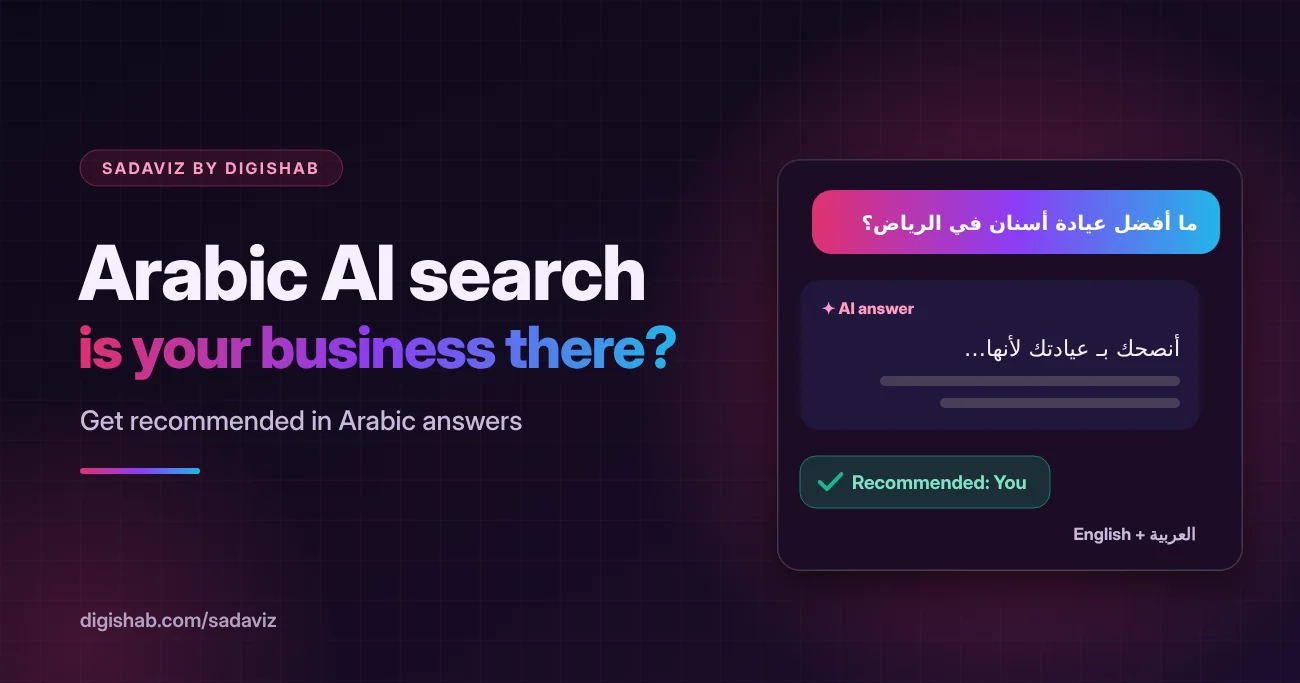
A customer in Riyadh opens ChatGPT and types in Arabic: which clinic is best for dental implants near me? A customer in Dubai asks Gemini the same thing in English. The two answers can recommend completely different businesses.
Most GCC businesses optimise only in English, if at all. That leaves Arabic AI search wide open. This guide shows how to make your business visible and recommended when customers ask AI assistants in Arabic.
Why Arabic AI Answers Are Different
AI assistants answer in the language of the question and prefer sources written in that language. When someone asks in Arabic, the AI looks for Arabic pages that clearly answer the question. If your website is English-only, or your Arabic is a quick machine translation, there is little for the AI to quote.
Arabic also has its own search behaviour. People mix Modern Standard Arabic with Gulf dialect, use different spellings for the same place or service, and sometimes type Arabic words in Latin letters. Content that reflects how real customers ask has a better chance of being matched.
Build Arabic Pages the Right Way
- Separate Arabic pages with their own URLs, for example
/ar/pages, not a language toggle that swaps text on the same URL - hreflang tags linking each English page to its Arabic version
- Right-to-left layout that reads naturally on mobile
- Arabic titles, meta descriptions and headings written for search, not translated word for word
- Arabic schema markup with your business name, services and areas served
Separate URLs let search engines and AI tools index and cite the Arabic version on its own, which is why we build Arabic as its own pages.
Write Arabic Content AI Can Quote
AI assistants cite clear, specific statements. For each key service, your Arabic page should answer in plain sentences:
- What the service is and who it is for
- Which cities and areas you serve, such as Riyadh, Jeddah, Dubai or Abu Dhabi
- How the process works, step by step
- How long it takes and what the customer needs to prepare
- How to contact you, including WhatsApp
Add an Arabic FAQ that uses the questions your team hears every day, in the words customers actually use.
Free AI scan
Can ChatGPT, Gemini and Claude recommend your business?
The free Sadaviz scan checks AI bot access, readable content, schema, quotable answers and trust signals in about 60 seconds, and explains every fix in plain language. Detailed report you can share on WhatsApp.
Make Your Business Details Match in Both Languages
AI tools cross-check facts. If your Arabic business name, phone number or address differs between your website, Google Business Profile, Maps and directories, the AI is less confident about recommending you. Use one official Arabic name and keep it consistent everywhere, alongside your English name.
Check That AI Bots Can Read Your Arabic Pages
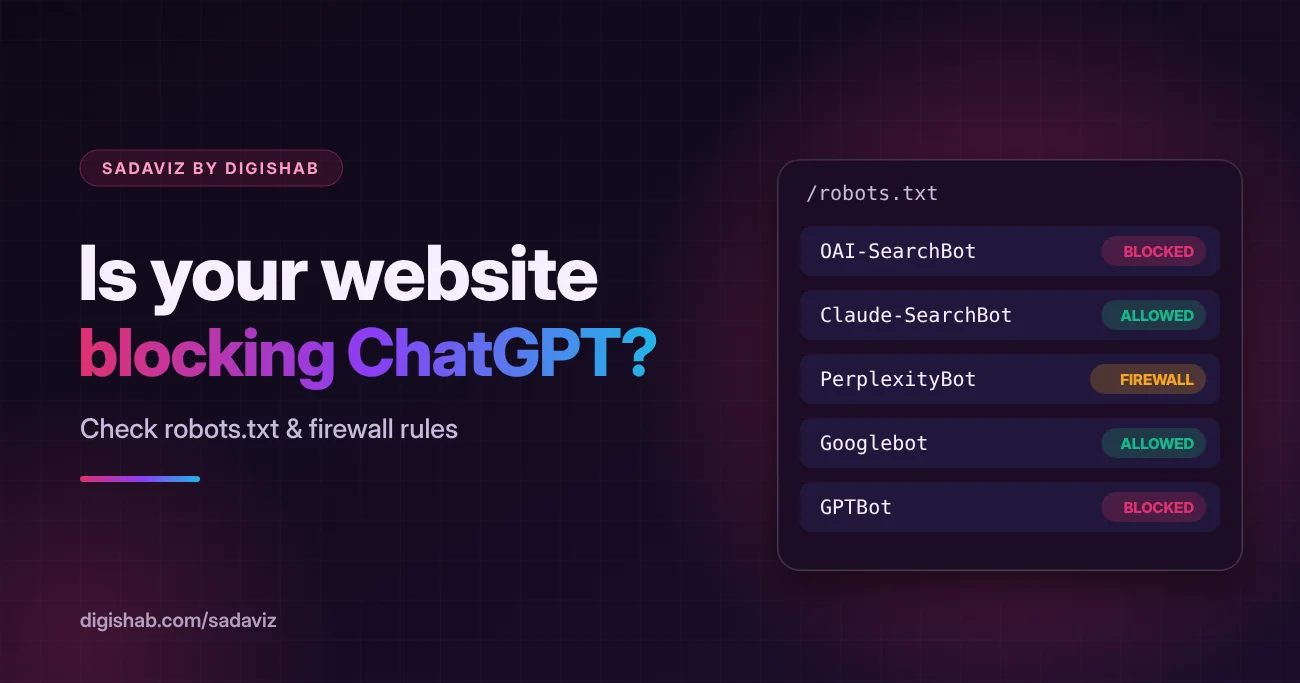
Arabic pages are often added later with a different plugin or subdomain, and sometimes they are blocked by mistake or load only with JavaScript. Make sure AI search bots can reach and read them. Our article on whether your website is blocking ChatGPT explains how to check.
Test Real Questions in Arabic
The simplest test is to ask. Write down ten questions customers ask about your service, in Arabic and English, and ask them in ChatGPT, Gemini and Perplexity. Note who gets recommended and which websites are cited. That shows you exactly where you stand against competitors.
Sadaviz does this systematically. The free scan checks your website’s AI readiness, and the Sadaviz AI SEO service tests real customer questions in English and Arabic, then fixes what stops AI from recommending you. Arabic readers can also visit Sadaviz in Arabic.
Talk to DigiShab
Want to know how AI sees your business? WhatsApp us: UAE +971 55 534 9010 · Saudi Arabia +966 53 462 3980 · info@digishab.com. Request a quote and we reply quickly.
Frequently Asked Questions
Does ChatGPT answer well in Arabic?
Yes. ChatGPT, Gemini and other assistants answer in Arabic and cite Arabic sources when they find good ones, which is why Arabic pages matter.
Is translated content enough?
Rarely. Literal or machine translation often misses how customers really ask. Arabic pages should be written or edited by someone who knows the market.
Should Arabic be on a subdomain or a folder?
Either can work, but a folder such as /ar/ on your main domain is usually simpler and keeps your authority in one place. Each page needs its own URL.
Do I need Gulf dialect content?
Modern Standard Arabic is the base, but including common Gulf phrases and spellings in FAQs can help match how customers in the region ask.